
Key Takeaways
- Answer Engine Optimization (AEO) optimizes a website to be cited as a direct source by AI search engines like ChatGPT, Perplexity, and Google AI Overviews.
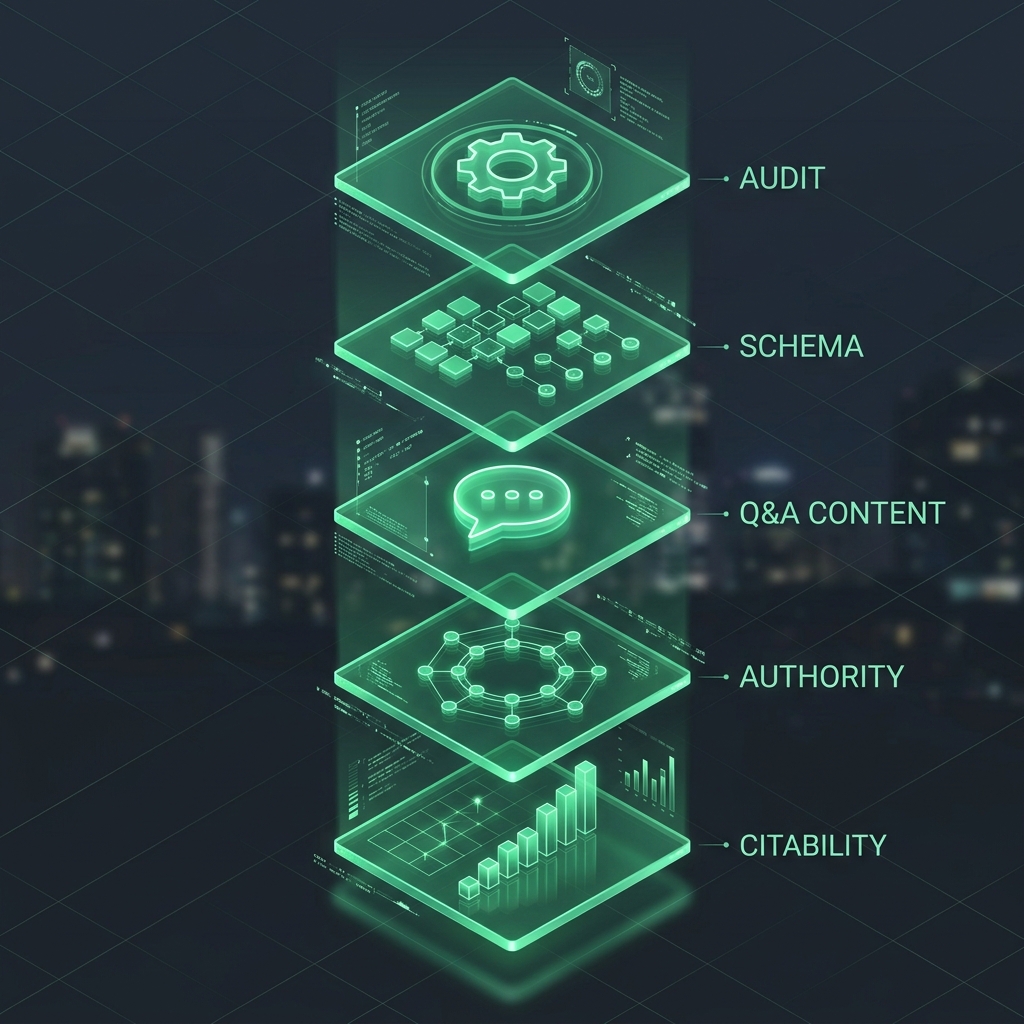
- This 5-step framework covers foundational technical audits, vertical schema markup, Q&A content restructuring, entity authority building, and citation tracking.
- The benchmark for B2B SaaS sites is to increase citation rates from a typical 5-10% unoptimized baseline to 25-35% within 90 days.
Answer Engine Optimization (AEO) is the discipline of optimizing a website to be selected as a source by AI-powered answer engines. Unlike traditional SEO, where the goal is to rank in a list of links, AEO aims to have your content extracted and cited directly within the engine’s response.
In 2026, answer engines process massive volumes: ChatGPT handles over 100 million weekly queries, Perplexity indexes 4.5 billion pages, and Google AI Overview appears in over 70% of informational searches. For B2B companies with SaaS products, citation in these engines is becoming a measurable acquisition channel.
This 5-step framework synthesizes the methodology we apply at Planet Communities for our digital products.
Step 1: Technical and structural baseline audit
Before optimizing for answer engines, a website needs a solid technical foundation. AI engines inherit quality signals from traditional crawlers: a site with 404 errors, redirect chains, or broken canonicals is less likely to be included in the source index.
The baseline audit must cover at least 30 technical checks: indexing (canonical, robots, noindex), content (H1, meta descriptions, thin content), performance (Core Web Vitals, TTFB), internal links (broken, generic anchors, redirect chains), and security (HTTPS).
An AEO audit platform executes these checks automatically and generates a quantitative score that serves as a baseline. This initial score is the starting point: any subsequent improvement is measured against this number.
Milestone: a technical score above 70/100 before moving to step 2.
Step 2: Implement vertical schema markup
Schema markup (JSON-LD) is the language used to communicate the semantic structure of your content to AI engines. Not all schemas have the same impact on AEO. According to data from SearchPilot and Authoritas, the types that drive the highest citability are:
FAQPage for informational content. Each question-answer pair becomes a direct candidate for source extraction. A 2025 study showed that implementing FAQPage increases appearances in AI Overviews by 23% for informational queries.
HowTo for guides and tutorials. Answer engines look for step-by-step sequences to answer procedural queries (“how to do X”). HowTo schema marks each step semantically.
Article with complete fields. Basic schema is not enough: the author (with a profile URL), datePublished, dateModified, and publisher fields are E-E-A-T signals that LLMs use to evaluate source reliability.
Product with offers and reviews for e-commerce or SaaS sites. AI engines cite product specifications when answering comparative transactional queries.
Milestone: 100% of landing pages and pillar content pages implemented with their corresponding vertical schema.
Step 3: Restructure content into a Question → Answer format
AI engines process queries in natural language. A heading that reads “Our Solution” is semantically opaque. A heading that reads “How automated technical audits work” directly matches the query “how does a technical audit work” and has a higher probability of being extracted as the answer.
Restructuring has three components. First, rewrite headings (H2/H3) as questions that users would ask a chatbot. Second, make sure the first sentence directly following each heading answers the question in under 50 words. Third, use the rest of the section to provide evidence with numerical data or verifiable comparisons.
This does not mean rewriting the entire site. Prioritize the 10 to 20 pages with the highest organic traffic and those answering queries where your competitors are already being cited.
Milestone: at least 15 pillar pages implemented with the Q&A format.
Step 4: Build entity authority
LLMs evaluate source trust through authority signals of the publishing entity. In practice, this translates into three actions:
Create or complete author profiles with Person schema, a verifiable LinkedIn profile, and listed publications. Articles with an identifiable author have a higher citation rate than anonymous ones.
Ensure the corporate entity (Organization schema) includes founding date, number of employees, area served, and same-as links to official profiles. AI engines cross-reference these signals with their knowledge bases.
Obtain mentions and citations from other relevant domains. LLMs do not just look at your site: they evaluate how many external sources reference you as an authority. Building thematic backlinks remains highly relevant in AEO, but with a twist: the topical relevance of the linking domain carries more weight than its generic Domain Authority (DA/DR).
Milestone: completed Organization schema, at least 3 authors with Person profiles, and at least 5 thematic domains referencing your brand.
Step 5: Continuous citability monitoring
Citability is not static: it fluctuates with every AI model update and with the content your competitors publish. Monitoring requires defining a set of 30-50 representative prompts and running them monthly across the three main engines (ChatGPT, Perplexity, Google AI Overview).
The primary metric is the percentage of prompts where your domain is cited. The secondary metric is the position within the citation list (first source vs. third). Tools like Peec AI allow you to automate this tracking and measure your GEO score over time.
The benchmark for B2B SaaS in 2026: an unoptimized site appears in 5-10% of non-branded prompts. After implementing steps 1-4, the realistic 90-day target is 25-35%.
Milestone: active monthly tracking with a positive trend for at least 3 consecutive months.
Framework Summary
| Step | Focus | Milestone | Estimated Time |
|---|---|---|---|
| 1 | Baseline technical audit | Score > 70/100 | 1-2 weeks |
| 2 | Vertical schema markup | 100% of landing pages | 2-3 weeks |
| 3 | Q&A content | 15+ pillar pages | 3-4 weeks |
| 4 | Entity authority | Organization + authors + 5 domains | Ongoing |
| 5 | Citability monitoring | Active monthly tracking | Ongoing |
At Planet Communities, we apply this framework to our digital products, including SEOdiag and the SciData site network. If your company needs an AEO plan tailored to your industry, let’s connect.
Frequently Asked Questions
- What is AEO (Answer Engine Optimization)?
- It is the discipline of optimizing a website to be selected and cited as a source by AI-powered search engines (ChatGPT, Perplexity, Google AI Overviews). Unlike traditional SEO, the goal is not just ranking in a list of links, but being cited directly within the generated AI answer.
- Does AEO replace technical SEO?
- No. AEO is an additional layer. Without a solid technical foundation (correct canonicals, working redirects, HTTPS, healthy Core Web Vitals), AI engines will not trust your site as a source. Step 1 of our framework is resolving the technical audit before optimizing for citability.
- How long does it take to implement the full AEO framework?
- Steps 1 to 3 (technical audit, schema, Q&A content) can be completed in 6 to 8 weeks. Steps 4 and 5 (entity authority and continuous monitoring) are ongoing processes. Measurable improvements in citability typically appear after 60 to 90 days.
- Which schema markup has the highest impact on AEO?
- FAQPage for informational queries (showing a +23% increase in AI Overviews appearances), HowTo for step-by-step guides, and Article with fully completed author and datePublished fields. Combining these covers most informational and procedural AI queries.