
Key Takeaways
- An AI Search Engine Optimization audit (AEO/GEO) adds semantic structure evaluation, entity trust, and LLM readability on top of traditional technical SEO.
- The audit assesses whether content answers direct questions in dense formats, whether Schema markup guides AI bots, and whether an llms.txt file is present.
- Integrating tools like Seodiag and Peec AI connectors enables calculating a quantitative GEO Score to track monthly AI citation growth.
The digital search ecosystem has evolved into a hybrid model: users continue searching on traditional engines like Google, but millions now ask complex comparison questions directly to AI assistants like ChatGPT, Perplexity AI, Claude, and Google AI Overviews.
To compete in this landscape, brands must execute an AI Search Engine Optimization (AEO - Answer Engine Optimization / GEO - Generative Engine Optimization) Audit.
This guide breaks down the core pillars required for an AI search audit in 2026.
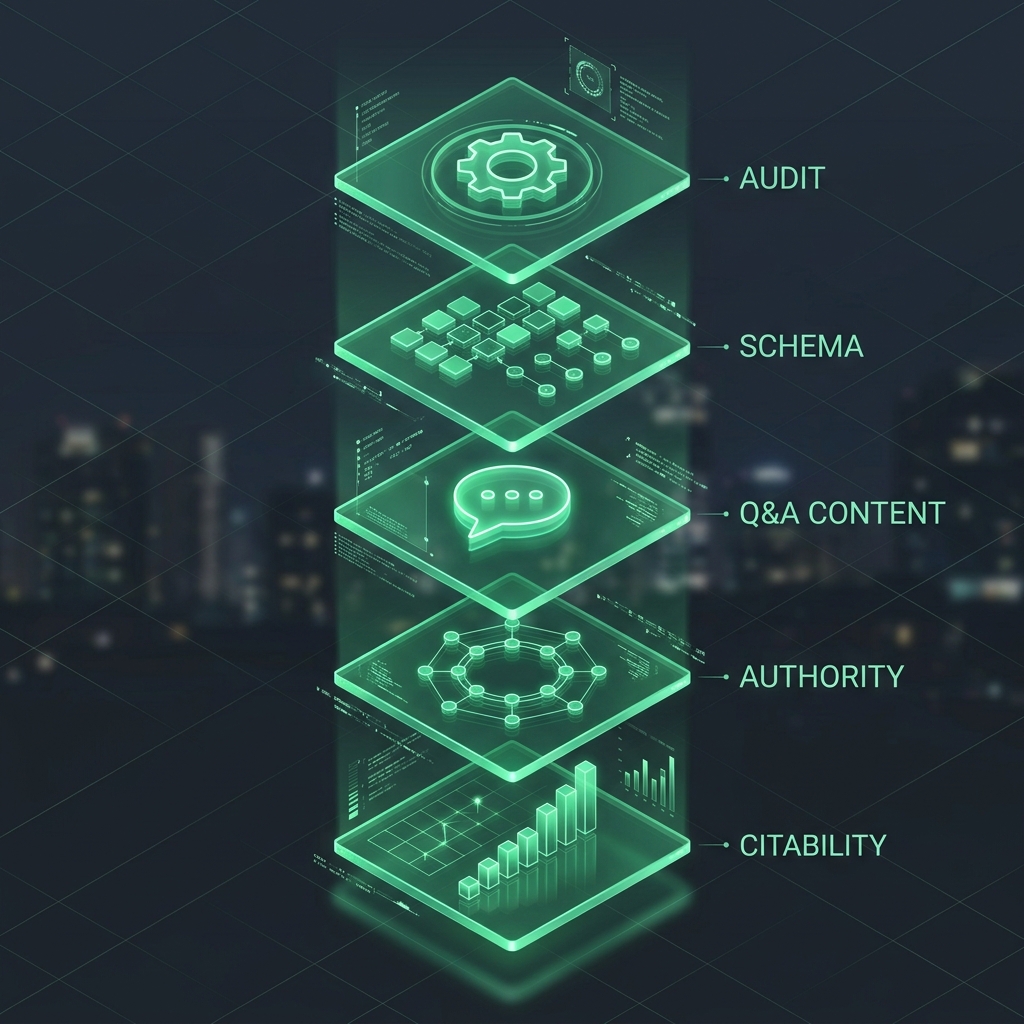
1. 5 Pillars of an AI Search Engine Audit (AEO/GEO)
Pillar 1: Readability & Q&A Semantic Density
LLMs are answer extractors. If your content consists of long, vague introductory paragraphs, AI models will skip it.
- Check: Are headings (H2/H3) phrased as natural language questions?
- Check: Does the first sentence following each heading deliver a direct answer (< 50 words)?
- Check: Are key comparison points formatted in tables and bulleted lists?
Pillar 2: Vertical Schema Markup
JSON-LD code acts as the map guiding AI model interpretation.
- Check: Is
FAQPageimplemented across informational articles and landing pages? - Check: Does
Articlemarkup include complete E-E-A-T metadata (authorwith profile URL,publisher,datePublished,dateModified)? - Check: Are
ProductorOfferschemas complete with accurate pricing and availability?
Pillar 3: AI Ingestion Configuration (llms.txt)
Just as robots.txt guides web crawlers, the llmstxt.org standard guides AI agents.
- Check: Is an
/llms.txtfile accessible in the root directory? - Check: Are company identity, core services, products, and citation policies explicitly documented?
- Check: Does
robots.txtpermit access to AI crawlers likeGPTBot,PerplexityBot, andClaudeBot?
Pillar 4: Entity Trust & E-E-A-T Verification
AI models penalize sources without verifiable reputation.
- Check: Does the
Organizationschema link to verified social profiles and authoritative external references? - Check: Do article authors have verifiable bio pages and industry presence?
- Check: Is your brand mentioned across relevant editorial domains?
Pillar 5: Citation Tracking & Share of Voice (GEO Score)
- Check: What percentage of industry prompts return your website as a source in Perplexity or ChatGPT?
- Check: How does your brand rank against direct competitors in AI comparison responses?
2. Checklist: Traditional SEO vs AI Search Audit
| Evaluated Aspect | Traditional SEO Audit | AEO / GEO AI Search Audit |
|---|---|---|
| Meta Tags | Title < 60 chars / Description < 145 chars | Dense conceptual summary in first 150 characters. |
| Headings | H1 → H2 → H3 hierarchy based on Keywords | Natural language questions matching AI prompts. |
| Schema Org | Basic (WebPage, BreadcrumbList) | Advanced (FAQPage, HowTo, complete Article, Organization). |
| Root Files | robots.txt + sitemap.xml | robots.txt + sitemap.xml + llms.txt. |
| Success Metric | SERP Rank #1-3 & Organic Clicks | Citation Rate & Share of Voice in LLMs. |
3. Automate Your AEO Diagnostic with Seodiag
Evaluating AI readiness requires connecting technical crawl data with AI search visibility metrics.
The SEOdiag.com platform combines technical audits of 200+ control points with AEO citation analytics, calculating your technical score and AI readiness in minutes.
4. Prepare Your Website for the Future of Search
Don’t let your brand get left out of ChatGPT, Perplexity, and Google AI Overview answers. Auditing and optimizing your site for AI search engines is the most high-ROI investment for digital visibility.
Want to evaluate your site’s AI readiness? Contact our team at Planet Communities.
Frequently Asked Questions
- What is the difference between a traditional SEO audit and an AEO/GEO audit?
- Traditional SEO audits evaluate how Google crawls and indexes links (keywords, backlinks, Core Web Vitals). AEO/GEO audits evaluate how LLMs (ChatGPT, Perplexity) extract and interpret content to cite it as a direct answer.
- What is an llms.txt file and why is it important in an AEO audit?
- It is a standard (llmstxt.org) located in the website root providing a clear, structured Markdown summary for AI agents to understand your brand and services without hallucinations.
- Does a high traditional SEO score guarantee good visibility in AI search engines?
- Not necessarily. A site can achieve 100/100 on Lighthouse, but if its content lacks Q&A structure or Entity markup, LLMs will cite better semantically-structured competitors instead.