
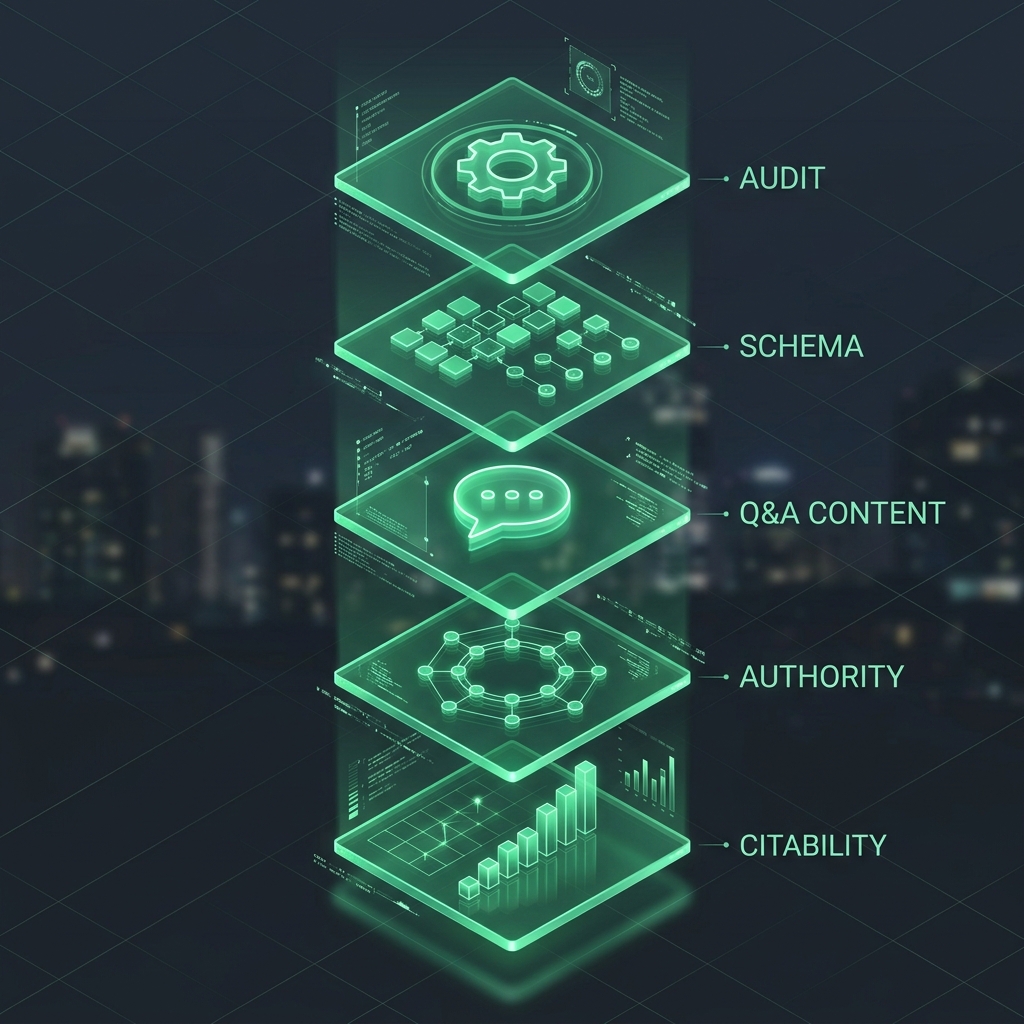
Key Takeaways
- Visibility in AI answer engines (ChatGPT, Perplexity, Claude) is measured via Citation Rate and Share of Voice in synthesized answers rather than traditional organic rankings.
- Auditing brand presence in generative models requires designing non-branded evaluation prompts, measuring URL extraction frequency, and auditing model sentiment.
- Using a platform with Peec AI MCP connector and Seodiag AEO scanner enables continuous tracking of topic gaps where competitors are cited while your brand is missing.
Search behavior has shifted dramatically: over 40% of informational and product comparison queries in developed markets now resolve directly within AI answer engines like ChatGPT, Perplexity AI, and Google AI Overviews.
For B2B companies and agencies, ranking in Google’s traditional top ten blue links no longer guarantees organic traffic if AI-synthesized responses bypass your brand completely. Measuring and auditing visibility in generative AI models (Generative Engine Optimization / AEO) requires entirely different methodologies and metrics than traditional SEO.
This technical guide outlines step-by-step how to audit your brand’s visibility across ChatGPT and Perplexity.
1. Key Metrics for AI Search Visibility
Unlike Google Analytics or Search Console, which measure absolute clicks and impressions, AI model presence is evaluated using four core metrics:
- Visibility Rate (%): Percentage of synthesized responses where your brand or product is explicitly mentioned within a specific prompt set.
- Share of Voice (SoV): Share of mentions your brand receives compared to direct competitors across the same query sample.
- Retrieval Rate & Citation Rate: Average number of times your domain’s URLs are retrieved as truth sources and cited in Perplexity or ChatGPT footnotes.
- Sentiment Score (0-100): Degree of positive or neutral sentiment with which AI models describe your brand’s value proposition.
2. 4-Step AI Visibility Audit Methodology
Step 1: Define a Non-Branded Evaluation Prompt Set
To get an accurate visibility baseline, do not search for your brand name. Define 30 to 50 non-branded queries that your ideal buyers ask AI chatbots.
Examples by intent:
- Informational: “How do I audit website visibility across AI search engines?”
- Comparison: “Best technical SEO audit software with AI features for agencies”
- Transactional: “Which cloud-based SEO tool provides automated reports under $100/month?”
Step 2: Evaluate Source Retrieval Percentage
Run your prompt set across ChatGPT (with web browsing active) and Perplexity AI. Audit the footnote citations:
- Was your website crawled and extracted?
- Did the AI model cite a direct competitor, an editorial site (TechRadar), or a UGC platform (Reddit, YouTube)?
If AI models consistently cite competitors over your domain, a citation gap exists that must be resolved in your structured content layer.
Step 3: Audit Entity Graph Consistency
LLMs cross-reference information across multiple knowledge nodes. If your brand has an incomplete Organization Schema, outdated author profiles, or a lack of topical backlinks, AI models will avoid citing your domain due to low Entity Trust (E-E-A-T).
Step 4: Automate Ingestion with APIs & MCP
Performing this audit manually across dozens of prompts every month is unsustainable. Combining connectors like Peec AI (via MCP protocol) and Seodiag enables automated monthly reporting.
3. Diagnostic Matrix: Why Isn’t AI Citing My Website?
| Observed Symptom | Probable Cause | Immediate AEO Fix |
|---|---|---|
| Site ranks #1 on Google but ChatGPT ignores it | Lack of Q&A blocks and flat semantic structure | Rephrase H2/H3s as direct questions with answers < 50 words. |
| Perplexity cites competitors in your niche | Missing FAQPage / Article Schema | Inject JSON-LD structured data with complete author & publication metadata. |
| AI mentions brand with outdated facts | Inconsistent Entity Graph across the web | Update Organization Schema and publish an /llms.txt file. |
| AI crawler cannot access site | Restrictive robots.txt directives | Allow access to AI crawlers like GPTBot, PerplexityBot, and ClaudeBot. |
4. Next Steps: Continuous AEO Optimization
Auditing visibility in ChatGPT and Perplexity is an ongoing process. With tools like SEOdiag and Planet Communities AEO frameworks, you can establish a clear baseline and track your brand’s monthly Share of Voice in the AI era.
Want to audit your brand’s AI search visibility with live data? Request a proposal from our team.
Frequently Asked Questions
- How is brand visibility measured in ChatGPT and Perplexity?
- It is measured by evaluating Citation Rate, Share of Voice (percentage of mentions over total industry queries), and Retrieval Percentage (how often your domain is extracted as a source).
- Why don't AI crawlers cite my website if it already ranks #1 on Google?
- Because LLMs evaluate additional signals such as Q&A semantic density, Schema markup (FAQPage/Article), entity authority, and cross-reference information consistency across external sources.
- How frequently should brand presence in ChatGPT and Perplexity be audited?
- Monthly monitoring is recommended across a fixed set of 30 to 50 informational and transactional industry prompts to track AI model response shifts.